Signs It's Time for Assisted Living: A Guide for Bluffton Families
A practical guide to recognizing changes, preserving dignity, arranging a trial stay, and planning with Lima-area cost figures.
A search for signs it's time for assisted living Bluffton often begins with a small observation: a refrigerator with little fresh food, a new bruise after a near fall, or a spouse who no longer sleeps through the night. One observation does not settle the question. A pattern across daily needs, safety, social connection, and caregiver capacity gives Bluffton and Beaverdam families a clearer basis for deciding what to do next.
No single sign makes the decision, and needing help is not a loss of dignity. The practical question is whether the present arrangement provides dependable support without asking too much of the older adult or their helpers. Treat assisted living as one option to investigate, not a conclusion reached in advance.
Signs it's time for assisted living Bluffton families can recognize
Start with your parent's own routines and abilities, not an idealized standard of housekeeping or independence. Changes that repeat, cluster together, or create risk deserve the most attention.
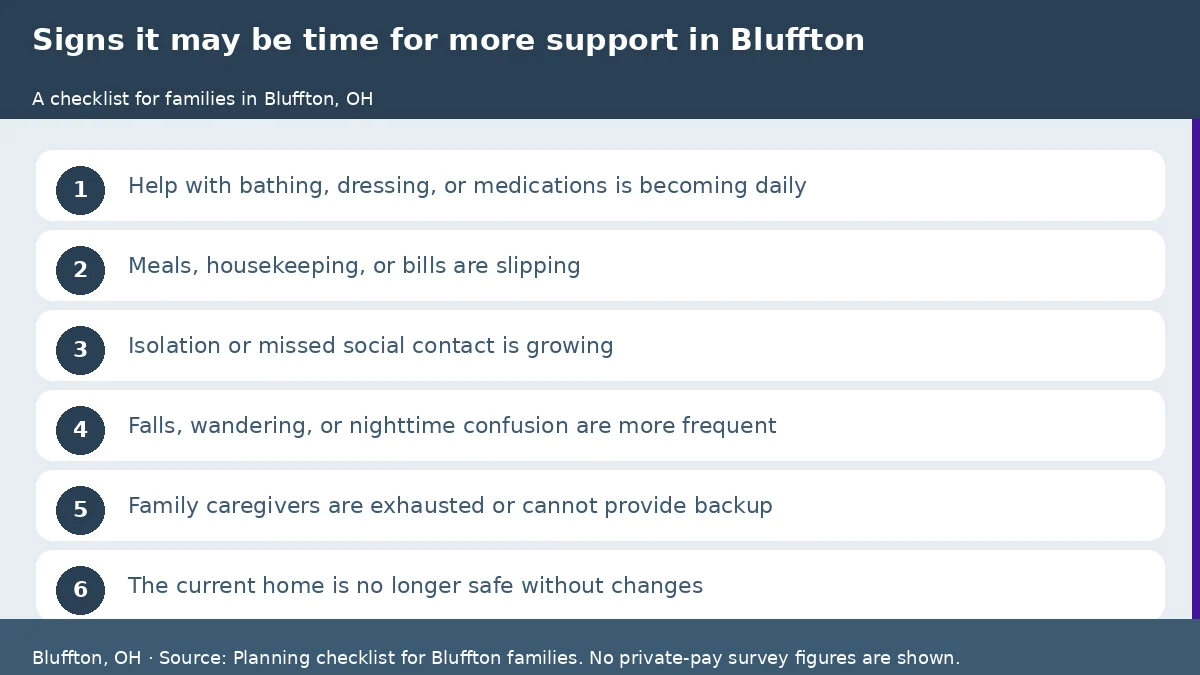
- Physical routines: bathing, dressing, toileting, or getting in and out of a chair becomes difficult, rushed, or dependent on another person.
- Household upkeep: laundry, dishes, mail, cleaning, and basic repairs pile up, or food is spoiled, missing, or repeatedly left uneaten.
- Safety: there are falls or near falls, an unattended stove, doors left open, difficulty using the phone, or uncertainty about how to call for help.
- Medication routines: doses appear missed or duplicated, containers remain full unexpectedly, or the schedule causes repeated confusion. Do not change doses yourself; seek a professional review.
- Social connection: church, clubs, familiar outings, and visits quietly disappear, leaving long stretches alone and few reasons to leave home.
- Caregiver strain: a spouse or adult child is persistently exhausted, missing work, neglecting appointments, or providing help that feels physically unsafe.
A single missed appointment may mean very little. Missed medication alongside an empty refrigerator and an exhausted spouse suggests a broader support problem. Immediate danger, such as an unsafe stove or inability to summon help, calls for prompt action rather than waiting to complete a checklist.
How to start the conversation with dignity
Choose a quiet time when no one is rushing or recovering from a crisis. Your parent should be part of the discussion from the beginning, not the subject of a decision made elsewhere. Lead with concern and specific observations, then leave room for disagreement, fear, grief, or a preference you did not expect.
- Ask permission to talk about how daily life is going, and listen before proposing a move.
- Describe what you have seen in neutral terms. Avoid labels, blame, and comparisons with other people.
- Ask what feels hardest and what matters most, whether that is privacy, pets, faith, familiar belongings, or staying near Bluffton.
- Offer a small next step, such as a needs assessment, a tour, or a discussion with a trusted professional, rather than demanding an immediate answer.
- Include siblings and other helpers early, but keep one calm line of communication so your parent is not facing a crowd.
Acknowledge that accepting help can feel like losing control. Keep choices real where safety allows: which communities to visit, what to bring, how a trial stay would work, and who should handle finances. Do not promise that home will never change or that a community will solve every problem.
Use respite or a short stay to gather information
A trial can replace speculation with everyday detail. The National Institute on Aging explains respite care as a short-term break for family caregivers, provided at home, through adult day centers, or during short residential stays. Where available, a brief stay lets a family ask concrete questions about meals, personal care, routines, and how staff respond when help is requested.
Respite is not a test of whether someone is worthy of independence, and it does not predict every future need. The the National Institute on Aging's respite guidance also describes planning and support for caregivers. Before booking, confirm the length of stay, staffing, medication support, furnishings, costs, cancellation terms, and what happens if needs change.
Adult day support may be another way to understand how structure and social contact fit a person's week. Richland Manor's current operations and any respite or adult day options should be confirmed directly; neither should be assumed from a general senior care description.
Understand Ohio licensing and the local fit
Ohio licenses assisted living as a residential care facility, often shortened to RCF. The Ohio Department of Health's assisted living guidance explains licensing, inspections, and the scope of services. Ask any provider for its current license status, recent inspection information, service plan process, staffing arrangements, and policies for changes in needs. Nursing needs deserve a specific discussion within Ohio's service limits.
Local fit also matters. Richland Manor's address is 7400 Swaney Rd, Bluffton, OH 45817, close to Beaverdam in Allen County. Families coming from Lima, Findlay, or elsewhere near Interstate 75 should consider the drive in ordinary weather, who can visit regularly, and how appointments and family communication would work.
The overview of care and support at Richland Manor can help frame a visit, but direct confirmation is essential. Ask whether assisted living or skilled nursing is currently offered, whether the community is operating and accepting residents, and what supervision is available. If cognitive change is a concern, do not assume a dedicated memory-care service exists.
What Lima-area cost figures mean for planning
Cost cannot decide whether support is needed, but it shapes what a family can sustain. The following medians come from the , with data collected from July through November 2025; they are planning benchmarks, not quotes for any community.
Adult day health care is shown separately because its schedule and services differ from residential care.
These figures are not Richland Manor rates. Apartment features, included services, care needs, and fee policies can change a quote. Use the Richland Manor cost page as a starting point, then call for current rates and request a written list of included services, possible extra charges, and how changes in support are handled.
Compare in-home support using the right geography
Home support is not automatically the lower-cost choice once enough hours are needed.
These snapshots do not include every household expense or community fee. Compare actual schedules, overnight supervision, meals, home upkeep, transportation, and caregiver backup. A few hours of help may fit one household well, while unreliable coverage between visits may be another household's central problem.
Review ways to pay without making assumptions
Medicare's long-term care guidance says Medicare does not cover long-term custodial care when that is the only care needed, and most long-term care is custodial. Do not assume that a hospital stay or a Medicare card will pay an ongoing assisted living bill. Ask how each charge would be paid before signing an agreement.
Long-term care insurance may help, depending on the policy. The Administration for Community Living's insurance overview notes that benefits commonly depend on an elimination period and needs involving daily activities or cognitive impairment. Read the actual contract, ask about covered settings and benefit limits, and confirm the claims process with the insurer.
Eligible wartime-era Veterans and surviving spouses may also want to review VA Aid and Attendance, an increase to a VA pension for people meeting care and other requirements. Current VA pension rates list a maximum annual pension rate with Aid and Attendance of $29,093 for a Veteran with no dependents, or $2,424 a month if countable income were zero. The net worth limit from December 1, 2025 through November 30, 2026 is $163,699. Actual pension is the applicable maximum minus countable income, and unreimbursed care expenses can affect the calculation. Confirm eligibility before rearranging finances.
Ohio's Assisted Living Medicaid Waiver can pay for services in certified assisted living facilities for people who meet age, care-need, and financial requirements and can pay the state-set room and board. The provider must be an ODH-licensed RCF certified by the Ohio Department of Aging. Apply through the Area Agency on Aging; county Job and Family Services determines financial eligibility. Neither eligibility nor Richland Manor's participation should be assumed.
A measured next step for Bluffton-area families
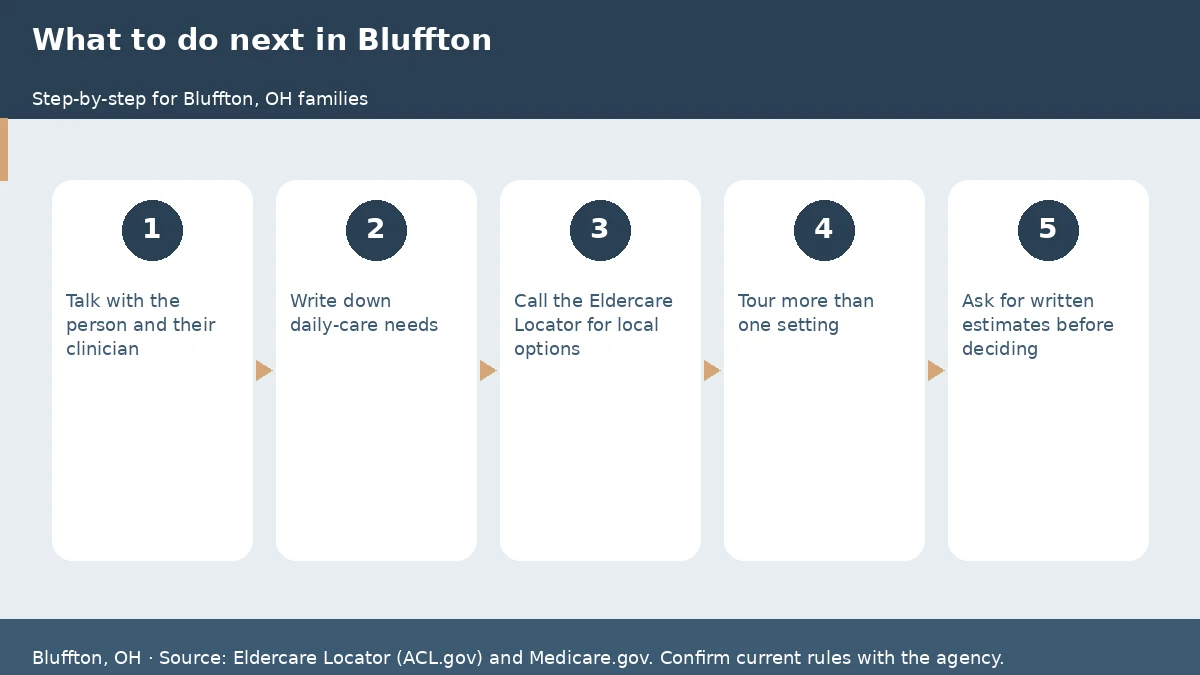
For anyone still weighing the signs it may be time for assisted living in Bluffton, turn the next week into a fact-finding exercise rather than a forced decision. Write down recurring concerns, identify any immediate safety gap, and ask your parent what a good day would require. Compare providers using the same questions and definitions of service.
The Eldercare Locator can connect families with local aging services, including the Area Agency on Aging. A primary care professional, pharmacist, social worker, or financial adviser may help within that person's own role. Keep your parent's preferences visible, and document who will handle each step.
A good plan does not require certainty about the future. It requires an honest picture of today, a safe backup for the needs that are hardest to cover, and a willingness to revisit the arrangement as circumstances change.
Frequently asked questions
What are the most important signs it's time for assisted living near Bluffton?
Look for a pattern rather than one bad day. In Bluffton and Beaverdam, common prompts include repeated falls or near falls, trouble with bathing or dressing, unsafe cooking, missed medications, a declining home, fewer social activities, and a caregiver who is exhausted or missing work. Immediate danger needs prompt attention. Otherwise, write down specific observations and discuss them with your parent and the appropriate professionals.
Is Richland Manor an assisted living facility, and is it accepting residents?
Richland Manor is described as a senior care community at 7400 Swaney Rd, Bluffton, OH 45817, near Beaverdam in Allen County. Families should confirm current operations, whether assisted living or skilled nursing is offered, and whether residents are currently being accepted. Also ask directly about respite stays and any dementia-related supervision or environment. Do not assume a particular service, license status, or availability without current confirmation from the community.
How much does assisted living cost near Bluffton?
These are survey benchmarks, not Richland Manor prices. Apartment type, services, and care needs can affect a community's quote, so call Richland Manor for current rates and request a written explanation of included services and possible extra charges.
Does Medicare pay for assisted living in Allen County?
Medicare generally does not cover long-term custodial care when that is the only care needed, and most long-term care is custodial. That limitation applies in Allen County just as it does elsewhere. Families should separate a specific covered medical benefit from ongoing help with meals, bathing, dressing, or supervision. Review the individual situation with Medicare and ask each community which charges are private pay.
Can a respite stay help a Bluffton family decide?
A short stay can show how your parent manages meals, personal care, medication routines, and social time without making an immediate long-term commitment. Respite may also be provided at home or through an adult day center. Near Bluffton, ask each provider whether short stays are offered, what support is included, and what the stay costs. Richland Manor's current operations and respite availability should be confirmed directly rather than assumed.
Talk with Richland Manor
If you are weighing care options in Bluffton, call (419) 999-8326 or plan a visit. Our team can talk through current availability, rates and next steps. Please confirm all details directly, since published figures and listings change over time.
Sources
- VA Aid and Attendance and Housebound benefits
- VA pension rates (current)
- Medicare: long-term care coverage
- Eldercare Locator (U.S. Administration for Community Living)
- National Institute on Aging: What is respite care?
- the National Institute on Aging: respite care
- ACL: What is long-term care insurance
- Ohio Department of Health: Residential Care Facilities (Assisted Living)
- Ohio Department of Aging: Assisted Living Medicaid Waiver Program (PDF)
Program rules and benefit amounts were checked on the linked official pages in November 2026 and can change.
Related reading on this site: