Ways to Pay for Assisted Living in Ohio: A Guide for Bluffton Families
A clear look at local costs, Ohio Medicaid, VA benefits, insurance, and private payment options for families considering senior care near Bluffton.
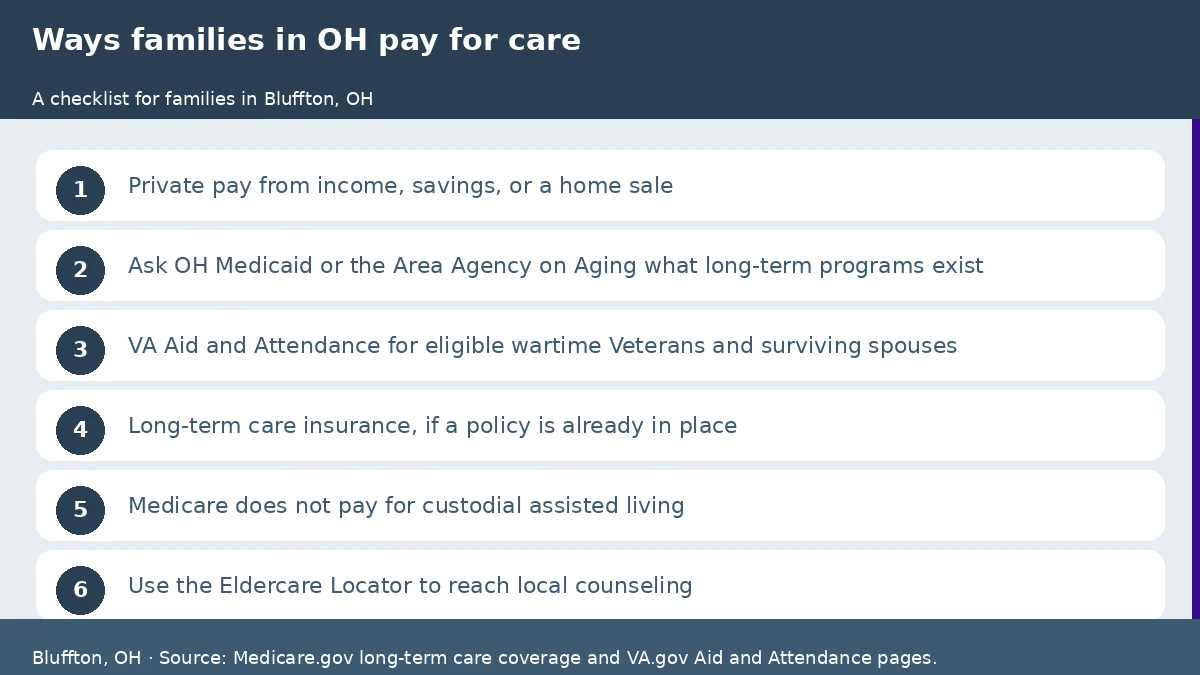
Families looking at senior care near Bluffton or Beaverdam often have to make two decisions at once: what kind of support is appropriate, and how to sustain its cost. Learning how to pay for assisted living in Ohio starts with separating the monthly service charge from the source of payment. Savings, a home, Medicaid, Veterans benefits, and insurance follow different rules, and none should be assumed to apply before eligibility and contract terms are checked.
Richland Manor is a senior care community at 7400 Swaney Rd, with a Bluffton, OH 45817 mailing address close to Beaverdam in Allen County. Its materials ask families to confirm current operations and whether assisted living or skilled nursing is offered. That makes direct verification of services, licensing, availability, and current rates an essential first step, not an administrative detail.
Use Lima metro costs as a budget benchmark
Cost surveys are useful for scale, not for a quote. , based on data collected July through November 2025, reports Bluffton under the Lima metro. Its assisted living benchmarks are:
Those differences are small beside the importance of the contract: meals, personal care, medication support, transportation, apartment features, and fee increases can be treated differently. Use the median to test a budget, then request an itemized written rate sheet. Richland Manor’s prices should not be inferred from these figures; families should call for current rates and confirm what care is presently offered.
How to pay for assisted living in Ohio with private funds and home equity
Private pay usually means combining Social Security, pensions, retirement-account withdrawals, savings, and contributions family members choose to make. Start with dependable monthly income and essential expenses for any spouse remaining at home. Then identify liquid reserves and the gap a community payment would create. A plan that works only while savings are being rapidly drained needs review before, not after, a move.
Home equity can be substantial without being readily available. Selling may provide proceeds, but timing and the net amount can be affected by repairs, taxes, transaction costs, and a spouse’s housing needs. Borrowing against a home creates repayment obligations and does not remove those risks. Before selling, borrowing, or transferring ownership, ask qualified financial, tax, and legal professionals to review the whole household. Do not treat an online valuation as spendable cash or an asset transfer as a simple route to benefits.
Ohio’s Assisted Living Medicaid Waiver Program
For eligible residents, Ohio’s Assisted Living Medicaid Waiver Program can be central to a sustainable plan. According to the Ohio Department of Aging’s program guidance, the waiver pays for services in certified assisted living facilities. It is not a blanket payment of every community charge. Eligibility includes:
- Being age 21 or older.
- Needing hands-on help with activities of daily living at a nursing facility level of care.
- Meeting Medicaid financial eligibility, including the countable-asset limit and income no higher than 300% of the SSI benefit. County Job and Family Services determines financial eligibility.
- Being able to pay the state-set monthly room and board.
The provider must be both an Ohio Department of Health-licensed residential care facility and certified by the Ohio Department of Aging. Listed waiver services include 24-hour on-site response, personal care, housekeeping, laundry, nursing, transportation, three meals a day, and social programming. Room and board remains a separate responsibility. Ask for a written division between waiver-covered services and room and board rather than assuming the full monthly charge is covered.
Apply through the Area Agency on Aging at 1-866-243-5678. Ask whether a waiver waitlist is in effect, what is required to join it, and when funding could begin. Also confirm the provider’s certification and whether it has an appropriate opening. A place on a waitlist is not a funding start date, and Richland Manor’s participation, current operations, and availability should not be assumed.
Verify Ohio licensing and the actual service package
In Ohio, assisted living is licensed as a residential care facility, or RCF, by the Ohio Department of Health. The state’s RCF guidance explains the licensing framework and an inspection cycle that includes at least one unannounced inspection every 9 to 15 months. RCFs may offer limited skilled nursing and other skilled care part-time, subject to a limit of 120 days in 12 months. That is different from assuming ongoing nursing home care is available.
Ask Richland Manor for its current license and service details. The overview of care and support at Richland Manor can frame that conversation, but families should still confirm current operations, whether assisted living or skilled nursing is offered, and whether the community is accepting residents.
VA Aid and Attendance for eligible Veterans and surviving spouses
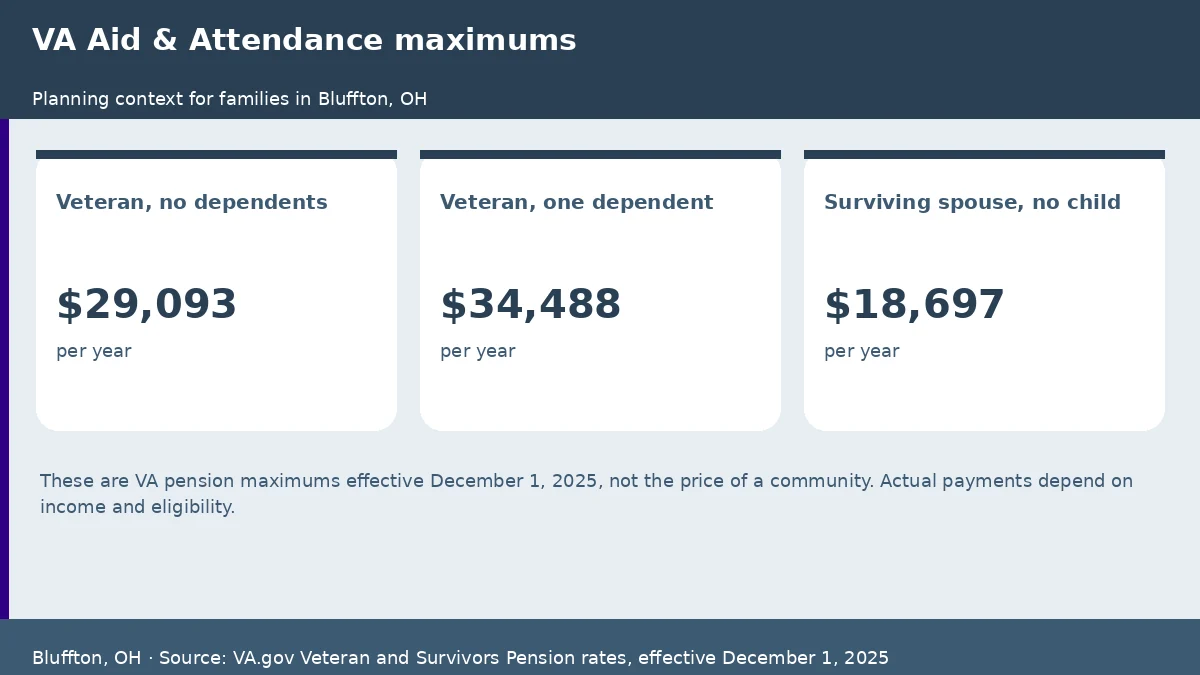
The VA’s Aid and Attendance guidance describes this benefit as an increased monthly amount added to a VA pension for wartime-era Veterans or surviving spouses who need help with daily activities or meet other listed criteria. It is not an automatic payment to an assisted living community.
The current VA pension rates, effective December 1, 2025, list these Maximum Annual Pension Rates with Aid and Attendance:
- If countable income were zero, the maximum monthly pension would be $2,424.
- If countable income were zero, the maximum monthly pension would be $2,874.
The VA net worth limit is $163,699 for December 1, 2025 through November 30, 2026. Pension generally equals the maximum annual rate minus countable income. Unreimbursed medical expenses, which can include care costs, above 5% of that rate may reduce countable income. The VA also reviews asset transfers during the 3 years before a claim, and a penalty period can last up to 5 years. Have the VA or a qualified benefits professional review service history, income, assets, and care expenses before relying on this benefit.
Long-term care insurance and Medicare have different roles
Long-term care insurance can pay for services such as assisted living, depending on the policy. Locate the actual contract and ask about the covered setting, benefit triggers, elimination period, payment method, duration, and claims documentation. Benefits commonly begin after an elimination period and when the policyholder needs help with activities of daily living or has cognitive impairment. The policy’s name alone does not establish coverage.
Medicare’s long-term care guidance states that Medicare does not cover long-term custodial care if that is the only care needed, and most long-term care is custodial. Do not use Medicare as an ongoing assisted living payment source. Any separately covered health service should be kept distinct from a community’s room, board, and personal-support charges.
Compare care settings before committing savings or home proceeds
These are not interchangeable price tags. Adult day care, home care, assisted living, and nursing homes provide different combinations of supervision, housing, meals, and support. Compare the help actually needed and the expenses that remain outside each figure.
Free guidance and a practical order of operations
For free guidance, start with the Eldercare Locator, a national service that connects families with local Area Agencies on Aging. Call 1-800-677-1116 and ask for the agency serving Bluffton, Beaverdam, and Allen County. Bring a list of diagnoses and daily-help needs, monthly income, assets, insurance policies, Veteran status, and current care expenses. Ask which benefits require an assessment and which financial determinations must go through county Job and Family Services.
At Richland Manor, request written confirmation of current operations, care levels, licensing, availability, and rates. The Richland Manor cost page provides a starting point for that discussion, but families should call for current rates rather than treating survey medians as community prices.
A workable answer to how to pay for assisted living in Ohio should identify who pays each charge, when benefits could begin, what reserves remain for a spouse, and what happens if care needs change. Putting those answers beside the contract and eligibility decisions leaves fewer assumptions at an already consequential time.
Frequently asked questions
What does assisted living cost near Bluffton, Ohio?
These are survey medians, not Richland Manor rates. Families should call for current rates, confirm current operations and the care level offered, and request a written explanation of included services, additional charges, and how rate changes are handled.
Does Ohio Medicaid pay for assisted living in Bluffton?
Ohio’s Assisted Living Medicaid Waiver Program can pay for services in a certified assisted living facility, but it does not remove the resident’s responsibility for state-set monthly room and board. Eligibility includes being at least 21, meeting care requirements and Medicaid financial rules, and being able to pay room and board. Apply through the Area Agency on Aging, ask about any waitlist, and confirm Richland Manor’s certification and participation directly.
Can VA Aid and Attendance help a Bluffton Veteran pay for care?
Aid and Attendance is an increase to a VA pension for eligible wartime-era Veterans or surviving spouses, not an automatic assisted living payment. Current maximum annual pension rates are $29,093 for a Veteran with no dependents and $34,488 for a Veteran with one dependent. The net worth limit is $163,699 for December 1, 2025 through November 30, 2026. Countable income and assets affect eligibility and payment, so individual circumstances need review.
Will Medicare pay for assisted living near Beaverdam or Bluffton?
Medicare does not cover long-term custodial care when that is the only care needed, and most long-term care is custodial. Families near Beaverdam and Bluffton should therefore not treat Medicare as an ongoing source of assisted living room, board, or personal-care payments. Separately covered health services do not turn Medicare into a long-term care payment plan. Confirm the community’s care level and ask how its charges are structured.
Is home care cheaper than assisted living in Allen County?
These figures do not make the settings equivalent: home care may leave housing, meals, utilities, and other supervision costs separate.
Talk with Richland Manor
If you are weighing care options in Bluffton, call (419) 999-8326 or plan a visit. Our team can talk through current availability, rates and next steps. Please confirm all details directly, since published figures and listings change over time.
Sources
- VA Aid and Attendance and Housebound benefits
- VA pension rates (current)
- Medicare: long-term care coverage
- Eldercare Locator (U.S. Administration for Community Living)
- ACL: What is long-term care insurance
- Ohio Department of Health: Residential Care Facilities (Assisted Living)
- Ohio Department of Aging: Assisted Living Medicaid Waiver Program (PDF)
Program rules and benefit amounts were checked on the linked official pages in November 2026 and can change.
Related reading on this site: