Assisted Living Tour Checklist for Bluffton Communities
A practical checklist to help Bluffton-area families prepare for an assisted living tour, ask clearer questions and compare written answers afterward.
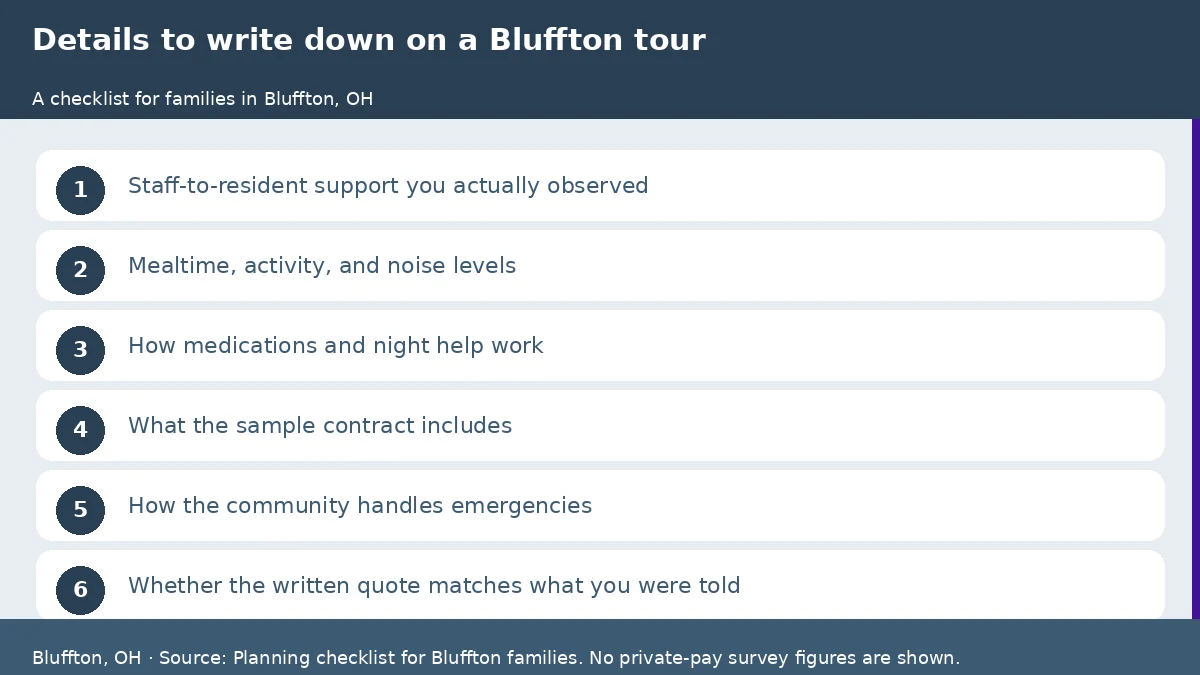
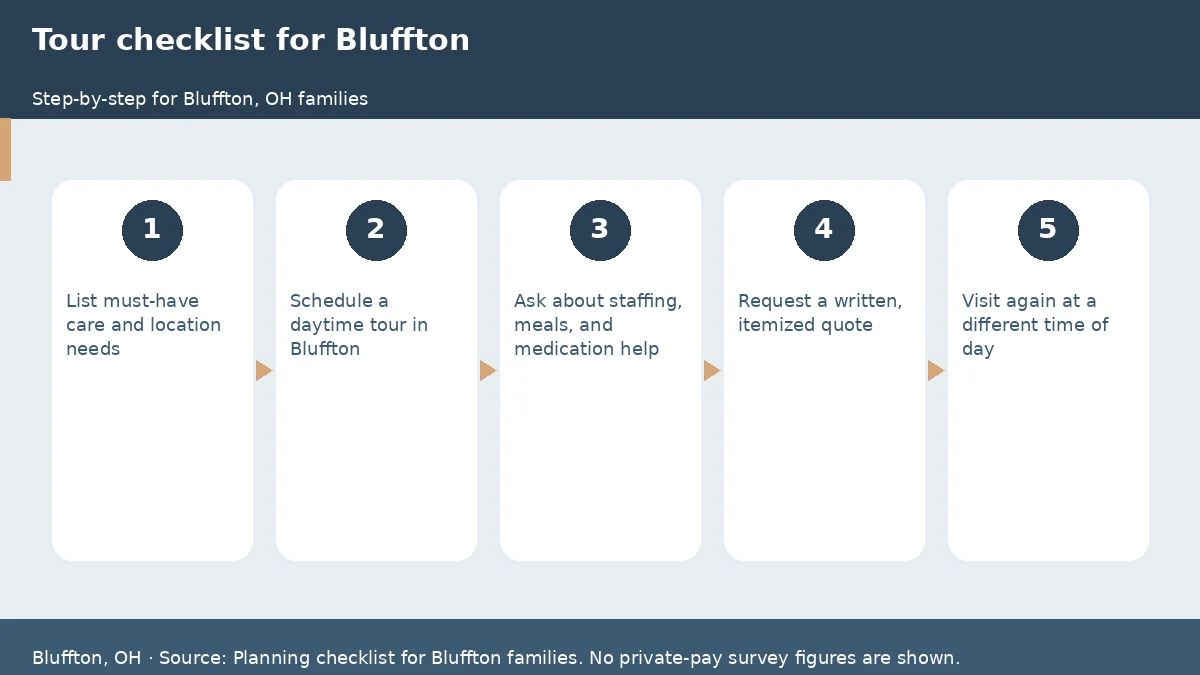
A tour is more useful when everyone listens for the same things and leaves with written answers. This assisted living tour checklist for Bluffton, OH, follows the order many visits take: preparation, arrival, care, safety, daily life, rooms, costs and follow-up. Copy the lists into a notebook. A polished lobby or busy calendar may be worth noticing, but neither explains how support works on an ordinary night or when needs change.
Richland Manor is a senior care community at 7400 Swaney Rd, with a Bluffton, OH 45817 mailing address near Beaverdam in Allen County. Richland Manor asks families to confirm current operations and whether assisted living or skilled nursing is offered, so establish those points, tour availability and admissions status during the first call rather than assuming them.
Assisted living tour checklist for Bluffton, OH: before you visit
Begin with a short call and a written list of priorities. Include the person who may move, when possible, and decide which questions require documents rather than verbal answers.
- Current fit: Confirm operations, the type of care offered, admissions status and whether the community can assess the person's present needs.
- Changing needs: Ask what happens if mobility, medication support or help with daily activities increases.
- Tour logistics: Confirm the date, expected length, accessible entrance, who will lead the visit and whether your loved one should attend.
- Documents: Request the service agreement, fee schedule, sample invoice and licensing information before decision deadlines arise.
- Assessment: Ask who evaluates care needs, what records are useful and how the resulting plan is shared with family.
- Family travel: Consider familiar routes from Bluffton, Beaverdam, Lima or Findlay, including Interstate 75 traffic and seasonal weather.
- Personal priorities: Write down privacy, routines, cultural preferences and other details that should not be lost in a general discussion.
Northwest Ohio weather can reveal practical details. On a winter or wet-weather visit, notice cleared entrances, floor mats, lighting and the route from parking to the door. In warm weather, ask about shaded outdoor areas and indoor cooling. These observations do not establish quality by themselves, but they help families picture routine visits and everyday movement.
First impressions and safety
Arrive with enough time to observe without rushing. A single tour cannot show every shift, so separate what you see from what staff confirm.
- Arrival: Are entrances, walkways and parking areas maintained, clearly marked and manageable for someone with limited mobility?
- Interior conditions: Notice lighting, odors, noise, temperature, clutter and whether shared spaces appear comfortable rather than merely decorated.
- Resident interactions: Do employees address residents respectfully, protect privacy and allow time for responses?
- Movement and falls: Look for handrails, clear paths, suitable seating and bathrooms that appear accessible; ask how residents request help.
- Building access: Ask about visitor procedures, secured entrances, after-hours access and how staff know who is in the building.
- Emergencies: Ask about severe weather, power interruptions, evacuation, fire drills and communication with families.
- Cleanliness and repairs: Ask how housekeeping concerns and maintenance requests are reported and followed up.
In Ohio, assisted living is licensed as a residential care facility by the Ohio Department of Health. The Ohio Department of Health's assisted living guidance explains licensure and oversight, including unannounced inspections. Ask which license currently applies, how inspection information can be reviewed and how deficiencies or complaints are addressed. A license is an important verification point, not a replacement for observing daily life.
Staff, care and daily support
Specific scenarios usually produce clearer answers than general statements about compassion or experience.
- A typical day: Who helps with bathing, dressing, toileting, eating and moving safely, and how is that help scheduled?
- Coverage: Which roles are present during days, nights, weekends and holidays, and how are unexpected absences covered?
- Care planning: How are preferences included, how often is the plan reviewed and who can request a reassessment?
- Medication and nursing: Who provides each service, what documentation is used and which needs would require another provider?
- Urgent changes: How are falls or sudden health changes handled, and when are families and outside professionals contacted?
- Training and continuity: Ask about orientation, ongoing training, supervision and whether residents regularly see familiar employees.
- Family communication: Identify the routine contact person, expected response process and how concerns can be escalated.
The care and support information for Richland Manor can serve as a starting point for these questions, not a substitute for confirming current services. Ask whether each support is included, carries an added charge or requires an outside provider. Also ask how residents are encouraged to make choices while receiving supervision and assistance.
Dining, activities and ordinary routines
Meals and activities affect whether a community feels workable day after day. Request examples rather than relying on a general description.
- Menu and choice: Review a current menu and ask about alternatives, meal times, snacks and accommodations for personal preferences.
- Dietary needs: Ask who reviews special diets and how changes are communicated to the people preparing and serving food.
- Dining assistance: Find out what help is available and whether residents can sit with people they know.
- Family participation: Ask whether visitors may join a meal and whether reservations or additional charges apply.
- Activity calendar: Look for variety, resident input and options for people who prefer quiet or small-group activities.
- Actual participation: Ask how employees invite residents who hesitate to join and what happens when attendance is low.
- Transportation and connection: Ask which outings, appointments, worship preferences or community connections can be supported.
A full calendar is less informative than whether activities reflect residents' interests. If possible, observe part of a meal or program. Notice whether employees appear hurried, whether residents can decline participation and whether the routine leaves room for rest and privacy.
Rooms and personal space
Ask to see the room type actually being discussed, if available, rather than assuming every room has the same layout or features.
- Access: Consider doorways, turning space, bathroom layout, flooring and the route to dining and shared areas.
- Requesting help: Ask how the call system works, where alerts go and what happens when a resident cannot use it.
- Comfort: Check natural light, ventilation, temperature controls, storage and space for familiar belongings.
- Furnishings: Clarify what is supplied, what families may bring and whether furniture can be rearranged safely.
- Privacy: Discuss visitors, roommate arrangements if relevant, locks, staff entry and personal routines.
- Upkeep: Ask about laundry, housekeeping, maintenance, internet or telephone service and which items appear on the bill.
Picture the room with the person's actual clothing, mobility equipment and keepsakes in mind. A room that looks spacious when empty may function differently once those items are included. Ask for measurements or another viewing if the family cannot judge suitability during the first tour.
Costs and contracts
Cost questions belong on the tour even when care fit is the first priority. The , using data collected from July through November 2025, reports Bluffton under the Lima metro. These are market figures, not quotes or predictions of an individual bill.
Those figures are not local quotes. Different settings also provide different services, so their prices alone do not establish which option is suitable.
- Written rate: Ask what the base charge covers and how a care assessment could change the monthly amount.
- Included services: Review meals, personal care, medication support, housekeeping, laundry, transportation and activities individually.
- Additional charges: Ask about supplies, a second occupant, guest meals, one-time fees and outside-provider expenses.
- Changes: Request the policy on reassessments, rate increases and notice to residents and families.
- Agreement terms: Read provisions on admission, discharge, absences, refunds, notice periods and responsibility for belongings.
- Billing: Request a sample invoice and identify who can explain a disputed or unfamiliar charge.
Market medians do not establish Richland Manor's prices. Call Richland Manor for current rates, care-related charges and availability, and use the Richland Manor cost page to organize questions that still need written answers. Compare options using the same services and likely needs rather than base rates alone.
Payment sources and coverage
Resolve coverage assumptions before planning a move. Each source has its own eligibility rules, documentation and limits.
- Medicare: Medicare's long-term care guidance says Medicare does not cover long-term custodial care when that is the only care needed. Do not assume it will pay an assisted living monthly bill.
- Long-term care insurance: Administration for Community Living guidance explains that coverage depends on the policy. Review the elimination period, benefit triggers, covered settings and required invoices.
- VA benefits: VA Aid and Attendance information describes an increased pension amount for eligible wartime-era Veterans or surviving spouses who meet care and other requirements. Eligibility needs individual review.
- Ohio waiver: The Ohio Assisted Living Medicaid Waiver overview describes services for eligible people in certified settings. Verify provider certification and room-and-board responsibilities directly rather than assuming participation.
After the visit
Review the visit while details are fresh. Keep observations, verbal statements and written commitments clearly separated.
- Fill the gaps: Send unanswered questions to one contact and request documents or clarification in writing.
- Check consistency: Compare the tour answers with the agreement, fee schedule, care assessment and licensing information.
- Return with purpose: If useful, arrange another visit at a mealtime or different part of the day and include your loved one.
- Test family logistics: Consider regular visiting routes, winter travel and how relatives from Lima, Findlay or nearby communities will share visits.
- Review readiness: Discuss care preferences, decision-making authority, finances and what would trigger another care review.
A useful assisted living tour checklist for Bluffton, OH, ends with a record the family can revisit without relying on memory. If several options remain, compare the same categories and note which concerns are unresolved. For Richland Manor, keep current operations, service type, admissions status and rates on that verification list until each has been confirmed directly.
Frequently asked questions
What should I confirm before touring Richland Manor near Bluffton?
Confirm current operations, whether assisted living or skilled nursing is offered, whether a tour is possible and whether the community is accepting residents. Richland Manor's address is 7400 Swaney Rd, with a Bluffton mailing address near Beaverdam in Allen County. Also ask for current rates, the care assessment process, staffing coverage, included services and contract documents. Write down who answered and the date so later information can be checked against the same questions.
What is the local cost context for an assisted living tour in Bluffton?
These are market medians, not Richland Manor's prices or a promise of availability. Ask the community for a current written rate, care-related charges and a sample invoice before comparing options.
Does Medicare pay for assisted living in the Bluffton area?
Medicare does not cover long-term custodial care when that is the only care needed, and most long-term care is custodial. That means families should not assume Medicare will pay an assisted living monthly bill. Separate, medically necessary coverage questions may need individual review. During a Bluffton-area tour, ask which charges are for housing and daily support, then review payment options with the community, the insurer and a qualified benefits adviser.
What license should an Ohio assisted living community have?
Ohio licenses assisted living settings as residential care facilities through the Ohio Department of Health. On a Bluffton tour, ask which license currently applies, how to review inspection information and how complaints or corrections are handled. Do not infer a license or service level from a community's name alone. Richland Manor specifically asks families to confirm current operations and whether assisted living or skilled nursing is offered, so include that verification in the first call.
What should families do after a Bluffton assisted living tour?
Review notes while the visit is fresh, marking each answer as confirmed in writing, observed or still open. Compare the same categories across communities: care, staffing, safety, dining, activities, room suitability and total charges. If possible, schedule a second visit at a different time and include the person who may live there. For Bluffton-area decisions, also consider winter travel, familiar routes and how often relatives from Lima, Findlay or nearby communities can realistically visit.
Talk with Richland Manor
If you are weighing care options in Bluffton, call (419) 999-8326 or plan a visit. Our team can talk through current availability, rates and next steps. Please confirm all details directly, since published figures and listings change over time.
Sources
- VA Aid and Attendance and Housebound benefits
- Medicare: long-term care coverage
- ACL: What is long-term care insurance
- Ohio Department of Health: Residential Care Facilities (Assisted Living)
- Ohio Department of Aging: Assisted Living Medicaid Waiver Program (PDF)
Program rules and benefit amounts were checked on the linked official pages in November 2026 and can change.
Related reading on this site: